
Panchgavya is one of the oldest formulations in Hindu tradition, referenced across Vedic texts, Ayurvedic scriptures, and temple practices for thousands of years.
Yet for many people, the name only recently entered everyday conversation, largely because of its growing role in discussions around pilgrimage access and temple customs at some of India’s most sacred shrines.
Understanding what Panchgavya actually is, where it comes from, and why it holds the place it does in Sanatan Dharma helps place these conversations in their proper historical and spiritual context.
Panchgavya: History & Singificance Summarised
- Panchgavya is a five-ingredient mixture derived entirely from the cow milk, curd, ghee, cow urine, and cow dung — and has been central to Hindu ritual purification for over 5,000 years
- It appears across foundational texts, including the Rigveda, Charaka Samhita, and Sushruta Samhita, where it is described as a purifying and medicinal preparation
- Beyond ritual use, Panchgavya has traditional applications in Ayurveda and organic farming, and continues to be used in temple ceremonies, home pujas, and pilgrimage practices across India
- In 2026, The Gangotri Temple Committee made Panchgavya consumption mandatory before entry, positioning it as a faith-based purification requirement, a move that has brought this ancient practice into renewed public focus ahead of the Char Dham Yatra season
What Does Panchgavya Mean?
The word Panchgavya comes from two Sanskrit roots: pancha, meaning five, and gavya, meaning that which is derived from gau, the cow. Together, they refer to a specific set of five cow-derived products that have been combined and used in sacred Hindu practices since the Vedic period.
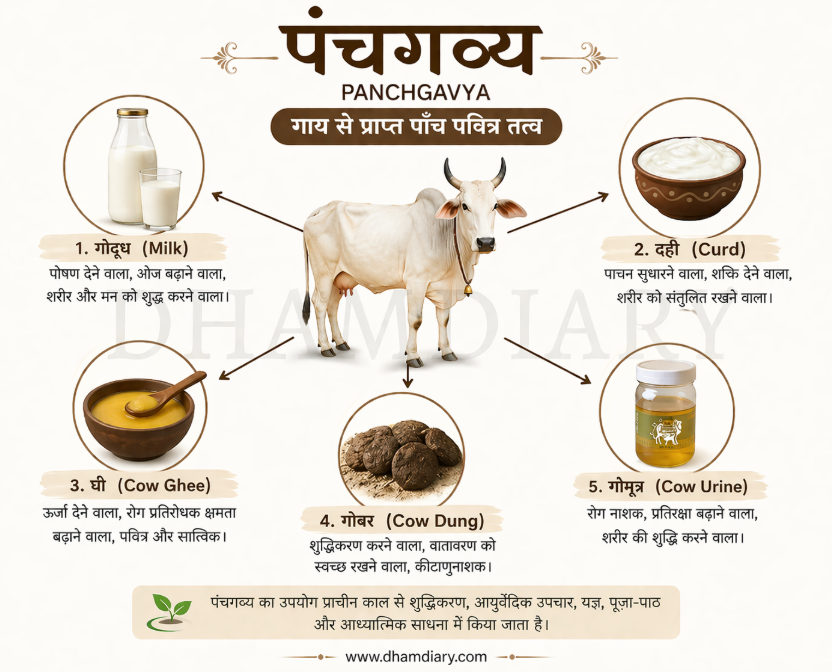
The formulation is also known as Panchakavyam in southern Indian traditions. While the name may vary, the composition remains largely consistent across regions and scriptural references.
The Five Ingredients in Panchgavya and What They Represent
Panchgavya consists of three direct products and two derived ones. The direct ingredients are cow milk, cow urine (gomutra), and cow dung (gobar). The two derived products — curd and ghee — are obtained from cow milk through fermentation and churning, respectively.
Each ingredient carries its own symbolic and functional significance within the tradition:
- Cow milk is associated with purity, nourishment, and the life-giving qualities of Gaumata. In ritual contexts, it represents sustenance and the connection between the divine and the material world.
- Curd symbolises transformation — the process by which something simple is converted into something richer. In Ayurveda, it is valued for its probiotic properties and its role in supporting digestion.
- Ghee holds a particularly elevated place across Hindu rituals. It is used to fuel sacred lamps and is offered in havan ceremonies as a medium through which prayers and offerings are believed to reach the divine. Ancient texts describe it as a carrier of spiritual energy.
- Cow urine (gomutra) is described in texts like the Atharvaveda and Charaka Samhita as a natural purifier. Traditionally, it has been used in ritual cleansing of spaces, objects, and the body before sacred activities.
- Cow dung (gobar) is used to sanctify spaces in Hindu households and temple courtyards. Its application on floors and walls before ceremonies is a practice that persists across rural India to this day.
When combined in the traditional ratio of 3:2:1:1:1, these five ingredients are mixed and left to ferment before use, a process that is believed to enhance both the spiritual potency and the practical properties of the mixture.
Panchgavya vs Panchamrit: What Is the Difference?
Two of the most commonly referenced sacred preparations in Hindu ritual practice, Panchgavya and Panchamrit are often confused. Here is how Panchgavya is different from Panchamrit:
Panchgavya is a five-ingredient cow-derived preparation used primarily for purification of spaces, individuals, and ritual environments before worship.
Panchamrit is a five-ingredient sacred mixture of milk, curd, ghee, honey, and sugar, used for bathing deities and distributed as prasad among devotees.
| Factor | Panchgavya | Panchamrit |
|---|---|---|
| Ingredients | Cow milk, curd, ghee, cow urine, cow dung | Milk, curd, ghee, honey, sugar |
| Primary Purpose | Purification of space, body, and ritual environment | Abhishekam (bathing of deities) and prasad |
| Who Consumes It | Devotee, as part of shuddhi before worship | Distributed to all devotees as a blessed offering |
| Ritual Timing | Before entering the sacred space | During the worship ceremony |
| Taste | Not consumed for taste — ritual in nature | Sweet, consumed as a devotional offering |
| Temple Use | Sanctifying premises, idol purification | Offered directly to the deity |
Panchgavya in Vedic and Ayurvedic Texts
The roots of Panchgavya run deep in India’s scriptural heritage. The Rigveda refers to the cow as aghnya i.e. not to be harmed, and describes cow-derived products as sacred offerings.
The Yajurveda prescribes cow products in ritual contexts specifically for purification and invoking blessings. The Atharvaveda praises gomutra and gobar for their purifying and healing roles in ceremonial settings.
In Ayurveda, the use of Panchgavya is documented extensively in the Charaka Samhita and Sushruta Samhita.
Here it is described under the concept of cowpathy and prescribed for supporting the balance of the three doshas — vata, pitta, and kapha. Ayurvedic practitioners have historically used individual components of Panchgavya, as well as the combined preparation, in formulations for various conditions.
It is worth noting that while traditional use is well-documented, modern scientific research on the clinical efficacy of Panchgavya’s medical claims remains limited and inconclusive. The tradition of its use is clear; the scientific consensus on health claims is not yet established.
Role of Panchgavya in Hindu Temple Rituals
Within temple tradition, Panchgavya has primarily served as an agent of purification. It is used to cleanse the temple premises, sanctify idols before and after major ceremonies, and prepare the ritual environment for worship.
During festivals like Gopashtami and Govardhan Puja, its use is considered an essential part of honouring the sacred relationship between the cow and the divine.
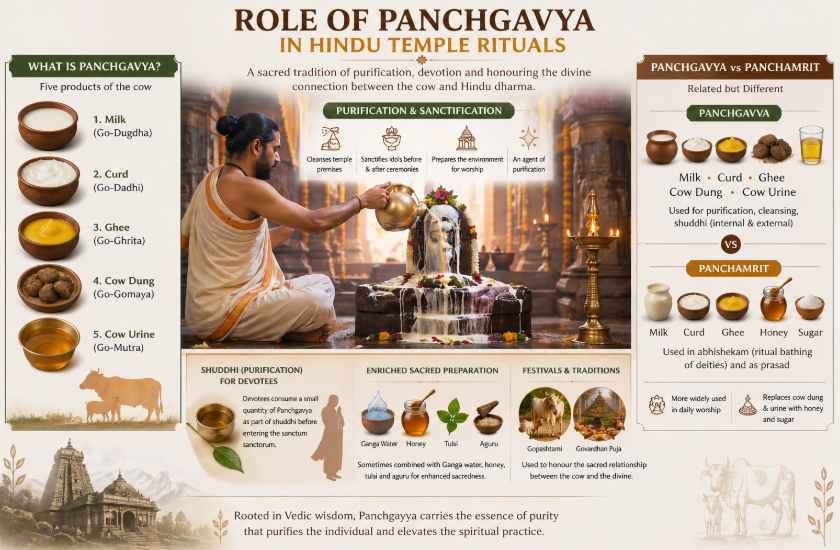
In certain rituals, devotees consume a small quantity of Panchgavya as part of a shuddhi (purification) process before entering the sanctum sanctorum.
This practice, rooted in the Vedic idea that the cow’s products carry a form of purity that transfers to the individual, has been observed at various temples across India for centuries. The mixture is sometimes combined with Ganga water, honey, tulsi, and aguru to form an expanded sacred preparation.
Panchgavya is also distinct from Panchamrit, another common ritual offering. Panchamrit replaces cow dung and urine with honey and sugar, making it more widely used in abhishekam (ritual bathing of deities) and prasad contexts. The two serve related but different ceremonial purposes.
Panchgavya in Modern Pilgrimage Practice
The Char Dham Yatra, the pilgrimage circuit covering Yamunotri, Gangotri, Kedarnath, and Badrinath attracts millions of devotees every year.
Planning a Char Dham Yatra involves understanding not just the route to Badrinath or how to reach Gangotri, but also the ritual and cultural norms that govern these sacred spaces.
In recent seasons, some temple committees managing these shrines have introduced or discussed the use of Panchgavya as part of entry protocols, framing it within the traditional practice of purification before darshan.
The Gangotri Temple Committee, for instance, introduced a requirement for visitors to consume Panchgavya before entering, a practice they described as consistent with the shrine’s longstanding ritual traditions.
The Badrinath-Kedarnath managing committee has taken related steps to affirm the Sanatan faith for entry.
It is worth noting that not all shrines in the circuit have adopted a uniform policy. Yamunotri, for example, has maintained an open-door approach, welcoming all registered pilgrims regardless of faith. Understanding these dos and don’ts for Char Dham Yatra at each individual shrine before undertaking the journey is now an important part of pilgrimage planning.
For those planning a visit, mandatory registration through the Uttarakhand government portal remains a requirement across all four dhams. Those above 55 or with pre-existing health conditions are also advised to complete a medical check before the Kedarnath trek and other high-altitude sections.
Char Dham Yatra for senior citizens has specific provisions in place, including pony, palki, and helicopter services to ease physically demanding sections of the route.
Panchgavya Beyond the Temple
Outside of ritual contexts, Panchgavya has found renewed attention in organic farming. It is used as a biofertiliser and natural pesticide, with farmers reporting improvements in soil health, crop resistance, and microbial diversity.
Personal care products incorporating cow-derived ingredients are also growing in popularity as part of a broader return to traditional formulations.
These applications reflect the versatility of a preparation that was never exclusively spiritual in its origins, it was always understood as something that served the body, the land, and the sacred space together.
Conclusion: Panchgavya has shaped Hindu ritual, medicine, and agriculture for millennia, long before it made the news
Panchgavya is not a new concept. It is a formulation that has been embedded in Hindu ritual, Ayurvedic medicine, and agricultural practice for a long time.
Its presence in contemporary pilgrimage discussions is simply the latest chapter in a long and documented history.
Whether one encounters it in a temple ceremony, an organic farm, or a Char Dham pilgrimage context, the underlying framework remains the same as a tradition built around the sacred status of the cow and the purifying properties attributed to its five products within Sanatan Dharma.
No. Panchamrit uses honey and sugar in place of cow urine and cow dung, making it suitable for abhishekam and prasad. Panchgavya is specifically a purification preparation and the two serve different ritual purposes.
The Rigveda, Yajurveda, and Atharvaveda all reference cow-derived products in ritual contexts. The Charaka Samhita and Sushruta Samhita further document its medicinal applications within Ayurveda.
Traditional Ayurvedic use prescribes it in specific quantities and preparations. Modern scientific research on its health claims remains inconclusive, so anyone with existing health conditions should consult a qualified practitioner before consumption.
It is used across India. In South India, it is known as Panchakavyam and holds a significant place in temple rituals, particularly in Tamil Nadu and Kerala.
Yes, by mixing cow milk, curd, ghee, cow urine, and cow dung in a 3:2:1:1:1 ratio in a copper or brass vessel and allowing it to ferment. Ingredients are best sourced from a verified gaushala for ritual use.
Only a small symbolic amount of Panchgavya is given at the temple entrance, not a fixed measured quantity.